Total Pageviews

Tuesday, December 13, 2016

Arctic Adventure Part 9 - Rooshia

Spent two days in St. Petersburg, Russia. 


Russia is an amazing place to see. Lots of interesting old buildings and museums. Lots of great art. And,,,,,I couldn't stand the place. The problem is that Russia is full of Russians. As individuals, Russians are terrific people (I think, I only got to know our guide - and I was paying her).  As a society, things seem to have gone off the tracks. My take was this - "Ve suffered for years, now it's your turn to suffer". Really?  All I want is a cup of coffee. How hard is that?  It seemed to me that the whole Russian society is passive/aggressive, dour and mistrusting. It's pervasive. In a lot of places I've visited across the world I stick out as a Westerner - easily.  Not Russia.  My complexion blends right in. Didn't do me any good though. Every encounter I had felt like a competition. "You vant coffee? Vy should I make it for you?" How 'bout because you're standing behind the counter in a coffee shop wearing an apron and I'm holding money?


Don't do any of these things - that includes blowing an air horn at a statue's face (bottom right)

I may not have felt welcome, but there sure was lots to see. To really appreciate the place it is vital to understand the history behind things.  Otherwise they make little sense. 


Stalin buildings


Putin buildings (I may be wrong)
Dreadful.  Keep in mind that there may be multiple families living in the same apartment.


Stalin buildings - note all the wide open spaces not being used
So why do most St. Petersburgians live in giant concrete apartment complexes? Simple, they're cheaper to make and cheaper to heat in the brutal Russian winter. As I said before, you really have to know Russian history to make sense of things.  Which meant that I was at a real disadvantage. Most of what I knew about Russian history I learned by reading ponderous Russian novels. The only thing I remember about having to read Anna Karenina (Tolstoy) in college is that it's 864 pages long, each page more depressing than the last. The Brothers Karamazov (Dostoevsky), more of the same. War and Peace, you get the idea.


Tolstoy
 By Sergey Prokudin-Gorsky - Журнал "Записки Русского технического общества", №8, 1908. Стр. 369. URL: http://prokudin-gorsky.org/arcs.php?lang=ru&photos_id=818&type=1, Public Domain, https://commons.wikimedia.org/w/index.php?curid=2324270


Here's Bill's Abridged Version of St. Pete history:

1703 - Tsar Peter the Great
By Paul Delaroche - 1. - 4. Unknown5. Bildindex der Kunst und Architektur, object 00031228., Public Domain, https://commons.wikimedia.org/w/index.php?curid=32937
recognizes the need for a Russian port.  He takes over Nyens from the poor swedes living there and names the city after himself (Russian kings have huge egos).  Builds the city using tens of thousands of "conscripted peasants" (read - slave labor). Most of them die.
Peter moves the capital from Moscow to St. Pete.

1725 - Peter the Great kicks the bucket.

1728 - Peter the OK (Peter II) moves the capital back to Moscow
By Iohann-Paule Ludden - http://www.varvar.ru/arhiv/gallery/rokoko/ludden/ludden2.html, Public Domain, https://commons.wikimedia.org/w/index.php?curid=32879792


I took this picture in the Hermitage.  May or may not be him.
 
1732 - Empress Anna moves the capital back to St. Pete

1732 - 1914 - a buncha stuff happens

1914 - WW I pisses off the government and they decide to 
get rid of the German in the name and start calling the place Petrograd.

1917 - Nicholas II abdicates the throne ending 300 years of monarchy rule (no loss, the Romanov's were spectacularly self-centered).
Nicky 2
By Boissonnas & Eggler, photographer, active 1902-1923, St. Petersburg, Nevsky 24. - Royal Collection, Public Domain, https://commons.wikimedia.org/w/index.php?curid=35263906

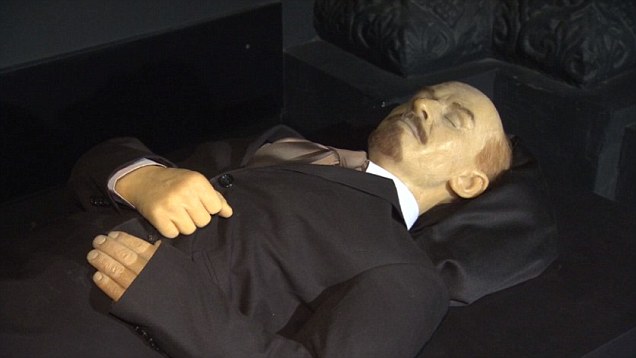
1917 - Lenin 

and his henchmen take over and establish the communist and Soviets.  They find a good deal on Craig's List apartments and decided to transfer the government back to Moscow (actually the threat of German invasion precipitates this)

1924 - Lenin takes a dirt nap (without dirt) and the city is renamed Leningrad.

1925 - Ioseb Besarionis dze Jughashvili takes over.


WW II - Germans try hard to take Leningrad.  

They besiege the place for 872 days but the Russians don't give up easily and 1 million people starve to death.


1945 - 1953 Stalin "Purges" Leningrad 


(meaning - murders almost everyone).  Keeps the capital in Moscow - this means he didn't have Leningrad bulldozed and lots of the cool cultural buildings remain.
Side note - the name 'Stalin' to a Russian holds much of the same stigma that the name 'Voldemort' 


holds to everyone in Harry Potter.  No one will say his name out loud (he-who-must-not-be-named).  Instead, they'll use the euphemism 'Soviet' to refer indirectly to him. I'm not exaggerating.  In the two days I spent with our guide she did not say his name once (and supposedly she was giving us an overview of Russian history - a waste of time with an ignoramus like me).  When I questioned her on this at the end of the tour, she blanched and changed the subject quickly without answering.

Took the tour over to Catherine's summer palace.  Just getting there was wild.  Catherine's summer palace is 20 miles south of St. Pete. It's most easily accessible by boat. Flashback to 1960's technology.


Russian hydrofoil
Riveted aluminum shell with twin black-smoke belching diesels.  Good for 30 loud, shaky knots.
The hydrofoil dock was typically Russian, but for some reason they felt compelled to put English translations on the signs.


During the Stalin era the penalty was firing squad. 

On the way to the palace you get to see some controversial sights.  

Zenit stadium under construction - supposed to be home to the 2018 FIFA World Cup (soccer) finals.  Lots of accusations of bribery by the Russians to Seth Blatter.  May or may not take place here. 
68,134 seats when completed
 Loved this bridge under construction.  There are actually two bridges like this one under construction.  Each seems to have reached the same stopping point.


I think they're on track to meet up precisely. This photo angle is a cool optical illusion. 

The bottom humps you see are the engine room intakes on the hydrofoil.

Ironically, Catherine's Palace wasn't actually commissioned by Cathy.  It was Empress Elizabeth in 1756
Liz - arguably not too bad of a ruler
By Vigilius Eriksen - http://korolev.msk.ru/books/919/kalendar2008_08/kalendar2008_08/h02-t.htm, Public Domain, https://commons.wikimedia.org/w/index.php?curid=10599585

who tore down her mom's place and re-did it in rococo style.
The place is simply stunning - which, of course, was the whole point. It gets worse - Liz wasn't satisfied with the construction until the 7th iteration. Liz had it torn down to the foundation 6 times before it was to her liking. You can only engage in this type of lunacy behavior if:

1. You're at the very top of the aristocracy..
2. You hold the power of life and death over your subjects
3. Your laborers are only paid 7 cents per day.
4. You're a recklessly extravagant whack job. 

So are you seeing the 7th version of the palace today?  Of course not.  That'd be too easy. Today you see a mixture of 7th and 8th (mostly 8th). The Nazis intentionally destroyed most of version 7 retreating from the siege of Leningrad.  Almost all that was left was the shell.


That being said, what you see today is mind-boggling:


If you look closely you'll notice the facade is orange, not gold. Originally it took 220 pounds of gold to gild the facade.  Guess who stole all the gold in WW II.


The gilding here is really gold.
Catherine took over the palace upon Liz's death, and about had a heart attack herself when she got the bill for finishing the gold statues:


Sadly, as beautiful as Catherine's summer palace is, it hasn't yet been fully restored.


The administration occasionally rents out the grand hall to raise restoration funds.  Elton John held a concert there in 2001. In 2005 they had a huge party that attracted Tina Turner, Bill Clinton, Sting, Whitney Houston, me (not).

The inside of the palace reflects the opulence of the outside and gardens. 


Every room has the beautiful blue corner pottery piece. It isn't a "water closet", it's part of the heating system. Delft pottery is made in Delft, Netherlands.
Normally you only see Delft pottery this sizeBy Kim Traynor - Own work, CC BY-SA 4.0, https://commons.wikimedia.org/w/index.php?curid=37650587


Care for dinner? Don't show up in a t-shirt and sandals. This is the gold dining room reserved for the very top of the food chain.

The "candles" here are electric.  Back in the day they used very expensive "smokeless" candles (no paraffin wax) to avoid blackening up the room paint.

One step down from the top aristocratic dining (silver instead of gold)


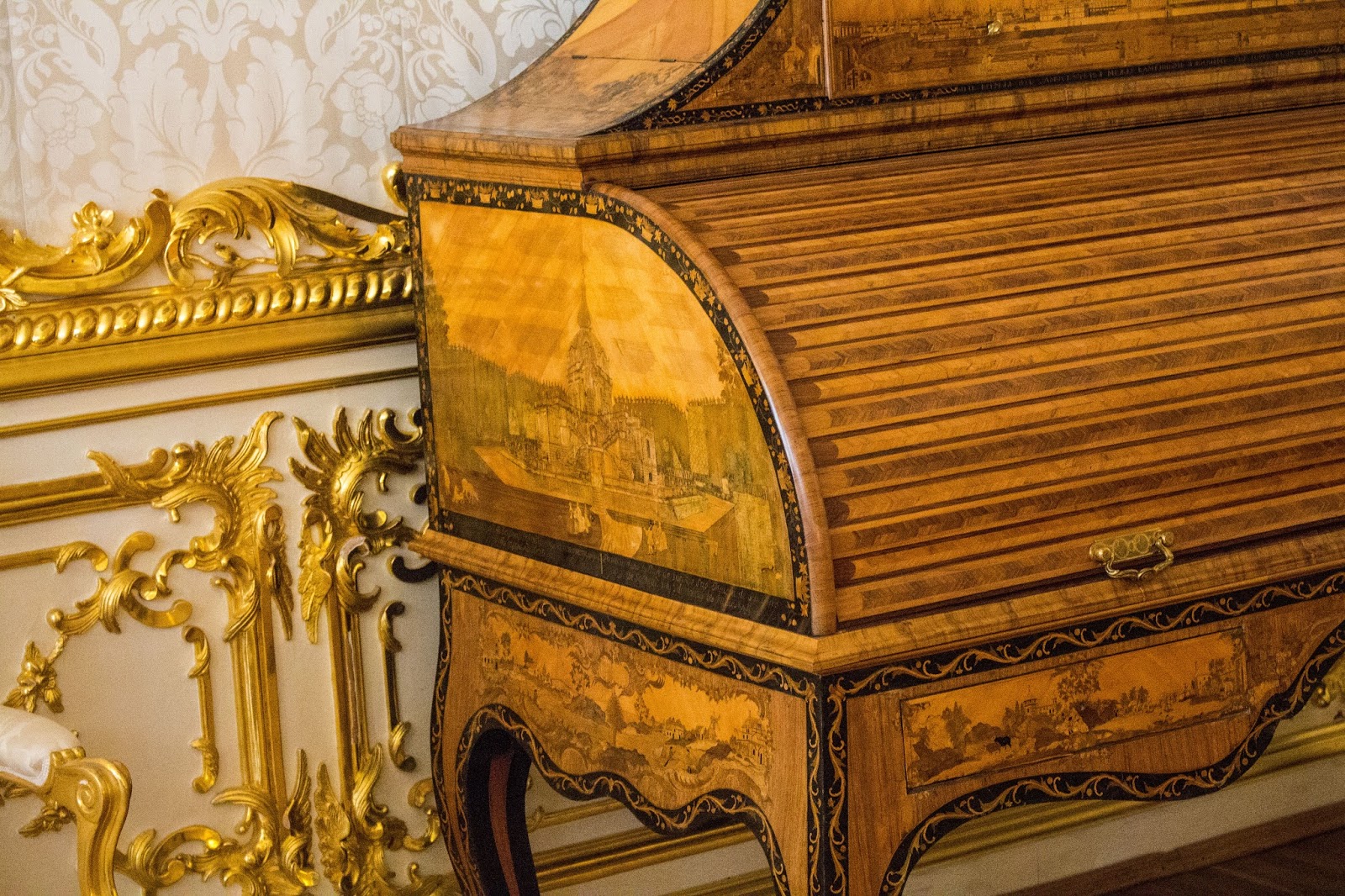
Inside the palace you will come across incredible wood works made by the masters.  This single desk took 10 years to make. Look closely at the craftsmanship. 
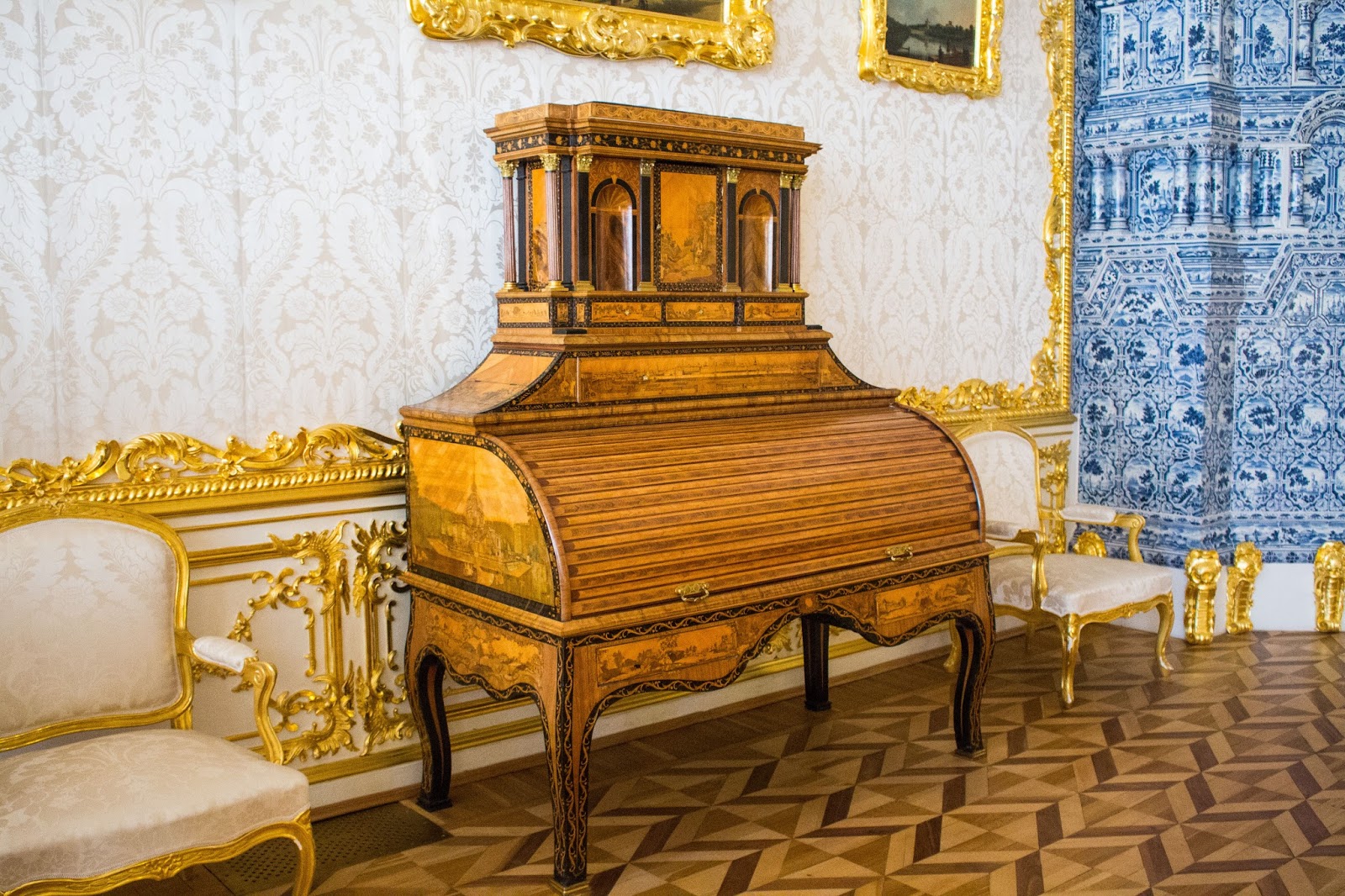


I would love to see this piece come through the door of "Pawn Stars" (Las Vegas pawn shop featured on the History Channel).  Rick's head would explode.

This desk only took 9 years to make.  If you ever see it in a garage sale, bring several million dollars with you.

The ballroom holds a special treat.  The ceiling has a very convincing optical illusion.

which you can't see in this shot


 OK, here it is

The ceiling looks curved - except that it isn't.  It's flat, but the painting illusion is so well done that until someone (tour guide) points this out you will not notice it's really flat.  In fact I had to back off to the side before it became apparent.

You can see it in this shot where I very carefully caught the light such that the ceiling painting is obscured slightly

OK, I'm lying.  I didn't set up this shot of the ceiling.  I just got lucky.


I'll conclude this posting on Russia with a projectile vomiting lion:


Monday, November 14, 2016

Arctic Adventure Part 8 - Blucher blunder, Estonia surprise

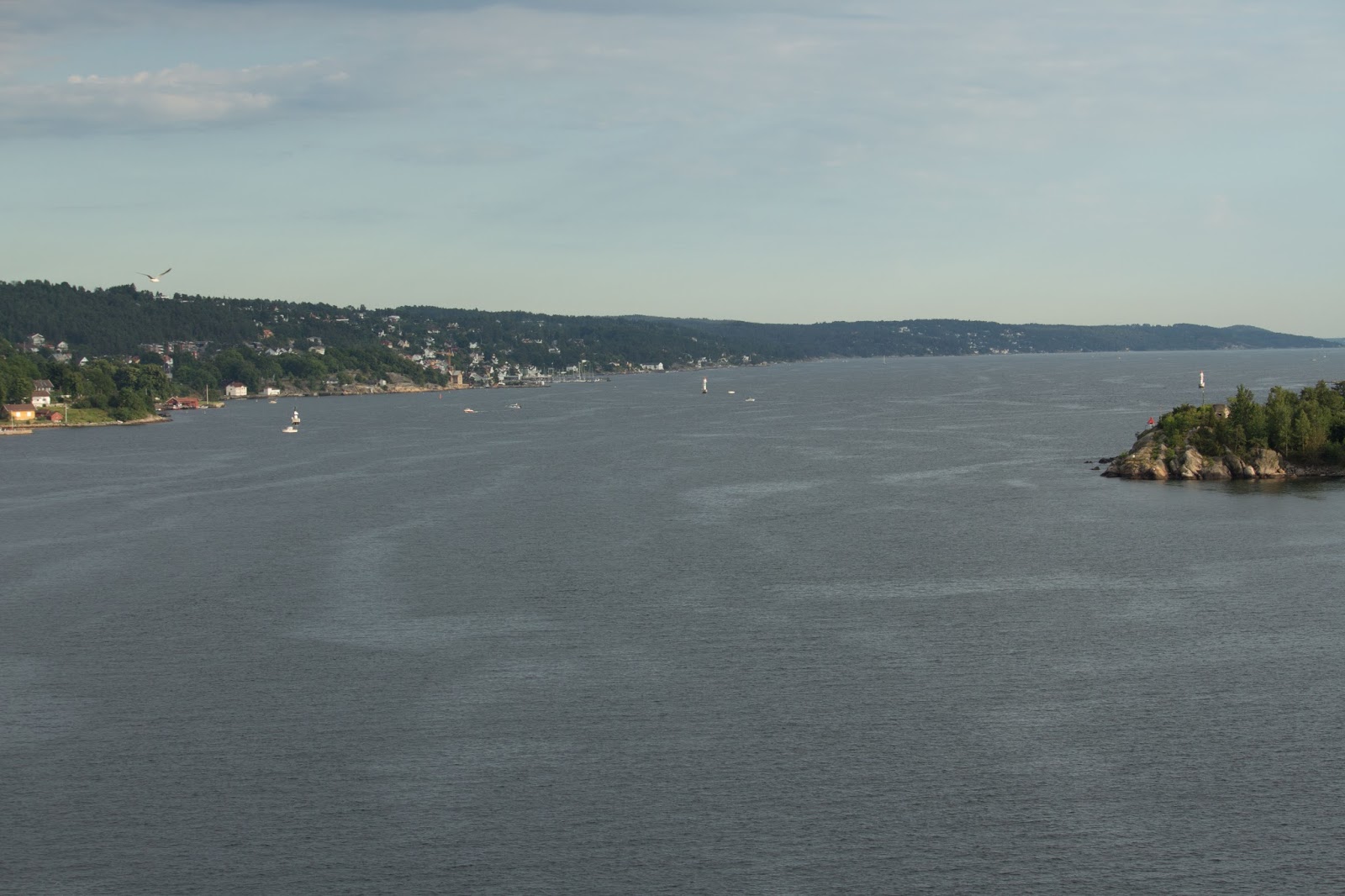
Leaving Oslo, Norway by ship you have to take a serpentine route.  This is Oslofjord. 


During the war, you also had to dodge these nasty buggers:


This didn't just wash up on shore - it is on display outside the Kon Tiki museum
If you've ever wondered how these things work - they're ridiculously simple (and effective).


The protuberance is called a "Hertz Horn".  Invented in 1870 they are still in use today.  The horn is nothing more than a lead pipe containing a glass vial filled with sulfuric acid. When some poor bastard ship bangs into the mine - the lead pipe bends, the vial breaks and the acid drains down into a dry lead acid battery. The battery comes to life (albeit briefly) and triggers the detonator.
There's an old naval expression that says EVERY ship is a mine detector - some only do it once.

Wandering down Oslofjord you will come to some narrows. If you're in charge of navigation - stay in the east channel around the island. When southbound, take the island to starboard.  This is really really important.


These narrows were not always as calm as they appear today. Here's the first clue.


Oil, slowly bubbling to the surface.

Look for Drobak on the map below.


From a military standpoint, Drobak is the perfect place to site a fort. All the way back in 1644 the Norwegians figured that out and built Fort Oscarrborg on the island in the middle. In a clever move they filled in the west side of the waterway with rocks that ended 3 feet below the surface. This wouldn't hamper small fishing boats and would force larger ships (at least the ones that knew about the hidden obstruction) to take the channel to the east.

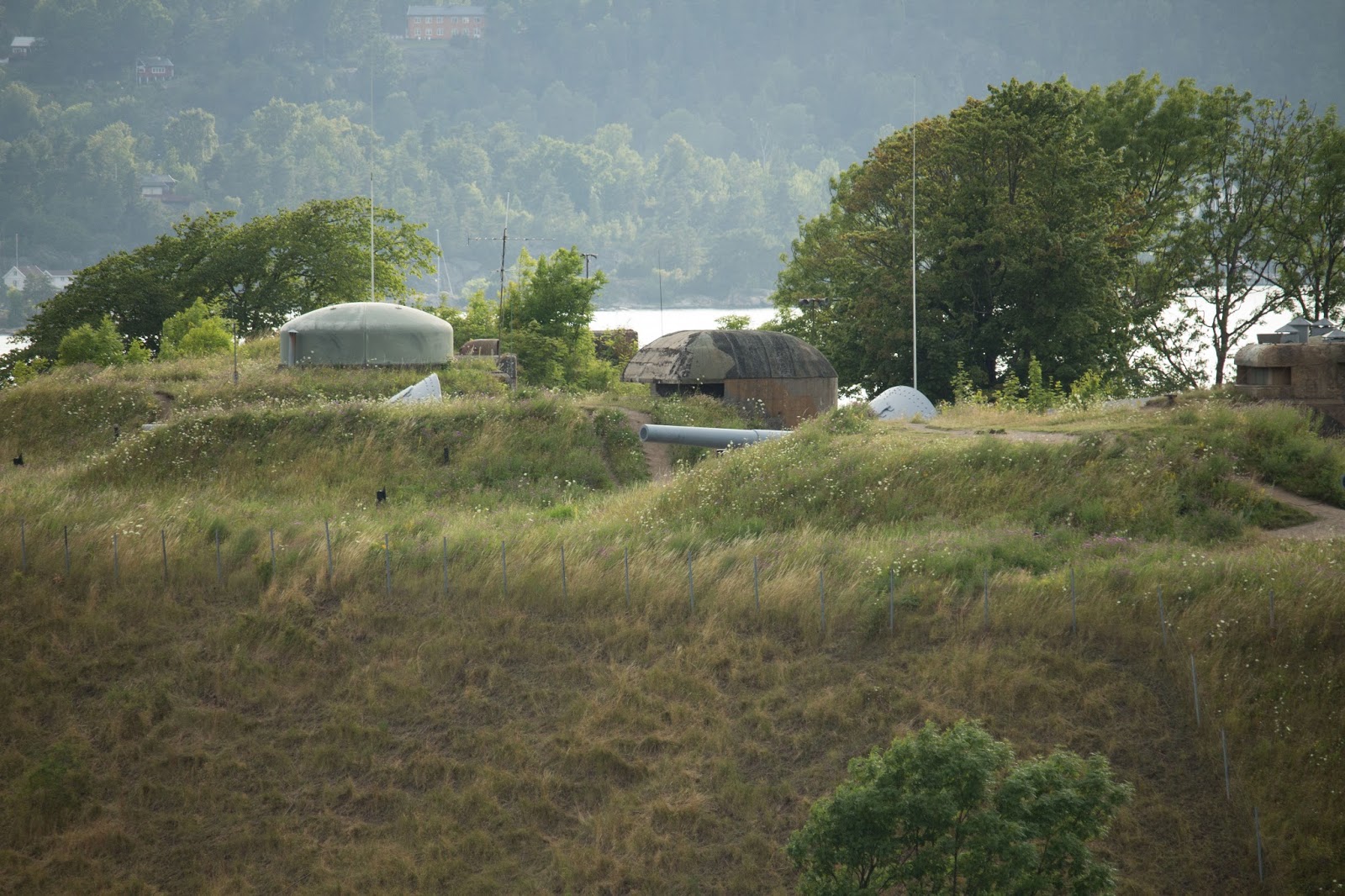
This is Fort Oscarrborg today:


Note the display of old muzzle loader cannons 


Observation tower

By the end of the 19th century every one knew that stone fortresses were now obsolete.  The Norwegians decided to upgrade the defenses anyway and proceeded to install 3 German 6 inch guns.


Note that the gun is completely dependent on manpower alone.  It is a breech loader, but everything has to be done by hand. For example - look at the back end of the gun for the big hand wheel to train the gun. The guy cranking left or right to aim the gun can't see what he's aiming at.

6" guns aren't all that big, but consider that by the time a ship came into range - it was a point blank shot. Then, in a very clever move, they installed 3 torpedo tubes on the back side of the island (and kept their mouths shut). Those torpedo tubes were one of the few things that WW II German intelligence knew nothing about. Ironically they were armed with German torpedoes the Norwegians had bought in 1900.

Sure enough, on April 9th, 1940, a German Kriegsmarine flotilla, lead by the heavy cruiser Blucher,

German heavy cruiser Blucher.  Went into service April 5, 1940.  8  8" guns, 3 aircraft. The ship was built to be used for years.  It only lasted 3 days. 
By Bundesarchiv, DVM 10 Bild-23-63-09 / CC-BY-SA 3.0, CC BY-SA 3.0 de, https://commons.wikimedia.org/w/index.php?curid=5372015

sailed up the fjord in a two prong pincer movement to capture Oslo (the other prong came over land to attack Oslo from the east).  They knew, of course, all about the 3  6" guns they'd be facing (hell, the Germans had sold them the guns). The Germans were expecting a ferocious firefight.  This was their first surprise - they didn't get one. The Norwegians got off a few shots, but nothing like what the Germans were expecting. For those old guns to be effective it takes a large group of highly trained, well rehearsed gun crews in peak physical condition to bring the guns to life. The Norwegians had siphoned off most of the soldiers of the fort for duty elsewhere. This is where the story takes an unexpected twist. All the old, retired guys in Droback put down their beers and said "Bullshit, we're not gonna let the damn krauts just sail up the fjord.  Let's do something".  So they did.  They drove over to the high school and rounded up all the boys that hadn't been drafted.  Anyone who has ever been around fired up old guys and teenage boys will recognize that this could be a very dangerous mix.  And indeed it was. Never screw with an old guy. We know all the tricks and we have less to lose.

The geezer garrison got off a few shots with the 6" guns but failed to score any crippling blows. The Norwegians really weren't expecting to stop them so easily. After all, they were facing a massive array of naval guns.

Then the German ships rounded the corner and fell into a trap they weren't expecting. The Norwegians nailed them with not one, but two of the, by then, 40 year old torpedoes. 

blucher on fire  By Riksarkivet (National Archives of Norway) from Oslo, Norway - Senkingen av Blücher, No restrictions, https://commons.wikimedia.org/w/index.php?curid=44299028 


The German torpedoes did an excellent job of setting the German warship on fire. Eventually the fires spread to the powder magazine and the Blucher (a brand spanking new ship) blew up and sank (with the loss of 1,000 men).

blucher sinking  By Unknown/Riksarkivet (National Archives of Norway) - https://www.flickr.com/photos/national_archives_of_norway/5654571951/in/set-72157626581002586, CC0, https://commons.wikimedia.org/w/index.php?curid=39226825  
So did this heroic action stop the invasion of Oslo?  Of course not. But it did delay the Germans by a full day - which was just enough time for the Norwegian government and royal family to escape to London and set up shop. As you would expect, the Germans were mad as hell.  The very next day the Luftwaffe flew over and bombed the hell out of the fort (killing and injuring no one). 

So how did a 40 year old torpedo managed to sink a modern steel ship?


Quite easily as it turns out.  They may have been 40 years old, but they were well maintained and it was a terrifically well designed torpedo. These torpedoes were so good that they didn't get taken out of service until 1993!

After the Blucher sank, it sat undisturbed on the bottom of the narrows (210 feet down) until 1991 when the oil leaks reached 11 gallons per day and the Norwegians decided it was becoming a threat to the environment. They sent down salvage divers and drilled holes in all the fuel tanks they could reach (133 tanks) and pumped out 1,000 tons of remaining fuel (which they promptly filtered and sold). Unfortunately, the Blucher had 180 fuel tanks and so it continues to slowly leak oil today.


We were on the way to Alesund, Norway when I spotted a bird I haven't seen in a while.

The bird with the bright red bill is an Oystercatcher.  They're not rare, I just haven't seen one in years.  While they aren't a large bird, apparently they pack quite a bit of attitude.  This one ran off the 3 gulls you see.

Alesund is a sea port that is known for it's Art Nouveau architecture. Simply put - the town is drop dead gorgeous.


If you're wondering how I got the aerial photos above, I walked up the "Fjellstua Viewpoint" winding staircase to the visitor center at the top of the hill:


486 steps, but with a Norwegian sense of whimsy they only put numbers on random steps (63, 187, etc.)

One of the cool things about the staircase (besides all the wheezing tourists around you and the fabulous view) is the railing.  It's fashioned out of wrought iron bars.

Alesund isn't a big place (45,000 lucky inhabitants) but it has a sad history.  In 1904 they had Mrs. O'Leary's cow on display at an exhibition.  The next thing you know - the entire town burned to the ground. Only one poor guy died, but 10,000 were left homeless (OK, I made up the part about the cow, but as we all know - cows are extremely dangerous and if they didn't taste so good should be eradicated from earth).
Norwegians aren't stupid, so when they rebuilt the town they used bricks instead of wood.

Estonia was quite a pleasant surprise.  Tallinn, where a third of all Estonians live, decided to bag the traditional city fountain and instead sponsor a balloon.


Tallinn was founded in 1248, but since this is Europe, actually dates back 5,000 years (Oh Lord, not again...that sound you just heard was me bonking myself in the head).  Estonia is one of those incredibly neat places where what you see is more or less the exact opposite of what they're really all about.  Here's what you see


This is called the Open Air Museum. It's a replica of an 18th century village. At first glance it seems quite primitive. The closer you look, however, the more clever you discover it really is. Take the roof:

Thick enough to keep the interior dry


             Also thick enough to provide excellent insulation.

This is  the kiln room (used for drying grain) - no point in letting all that heat go to waste (animals loved it here in the winter).  If you don't thoroughly dry grain it will be rendered inedible by fungus.
Where there's grain - there's rodents.  See picture below for explanation of this large hole.


This stone grain grinder is more sophisticated than it first appears.  Just pour the grain in the hole in the center, grab the stick and give it a spin - the flour comes out the sides.
Native American equivalent tool (rather primitive by comparison).
Hard to tell what this is. Hint - not used for cosmic research or torturing prisoners from Russia. 

This is our cute bike tour guide perched on it - it's the village swing set.
Our bike tour guide - flawless unaccented English, college educated, co-owner of business.

Biking over to Tallinn's old town you will find one of Europe's best preserved medieval cities.  In fact, it's now a UNESCO  world heritage site.


That being said, it's a little on the creepy side.


So, after visiting a buncha old stuff, it came as a surprise to find out what Estonia is all about today. Here's a hint:

As it turns out, Estonia is considered the "silicon valley" of Europe. Tallinn is the birthplace of Skype.  


In 2011 Micro Soft paid $8.5 B to acquire Skype.  It has been estimated that there are at least 1,000,000,000 world-wide users of Skype (myself included). Skype started in Tallinn and currently almost half of the division still live here. Tallinn has more start ups per person than all of Europe. There's so much software talent in Tallinn that it was chosen to be home to NATO Cyber Defense Center of Excellence. Not bad for a city of less than 1/2 million inhabitants!

Next up - Mother Russia.